

A bedside commode is a portable toilet chair designed for people who may have difficulty reaching or safely using a conventional bathroom. It can provide a practical toileting option near a bed, in a recovery area, on a floor without an accessible bathroom, or anywhere walking distance and nighttime safety are concerns.
The right bedside commode depends on much more than price. Before choosing one, consider the user’s transfer ability, body measurements, required seat height, weight capacity, available room, caregiver needs, and preferred method of handling waste. Some users may need a simple adjustable commode, while others require removable arms, bariatric dimensions, shower compatibility, or a more advanced waste-management system.
This guide explains the main types of bedside commodes, how to measure for a proper fit, which safety and comfort features matter most, and how the Wrappon ORB Auto-Wrapping Portable Toilet System offers an alternative to carrying, emptying, and cleaning a traditional commode bucket.

What Is a Bedside Commode?
A bedside commode is a freestanding toilet chair that can be placed near a bed or in another convenient area. Most conventional models collect waste in a removable bucket positioned beneath the seat. Other designs can be placed over a household toilet, used as a toilet safety frame, transported into a shower, or paired with disposable liners.
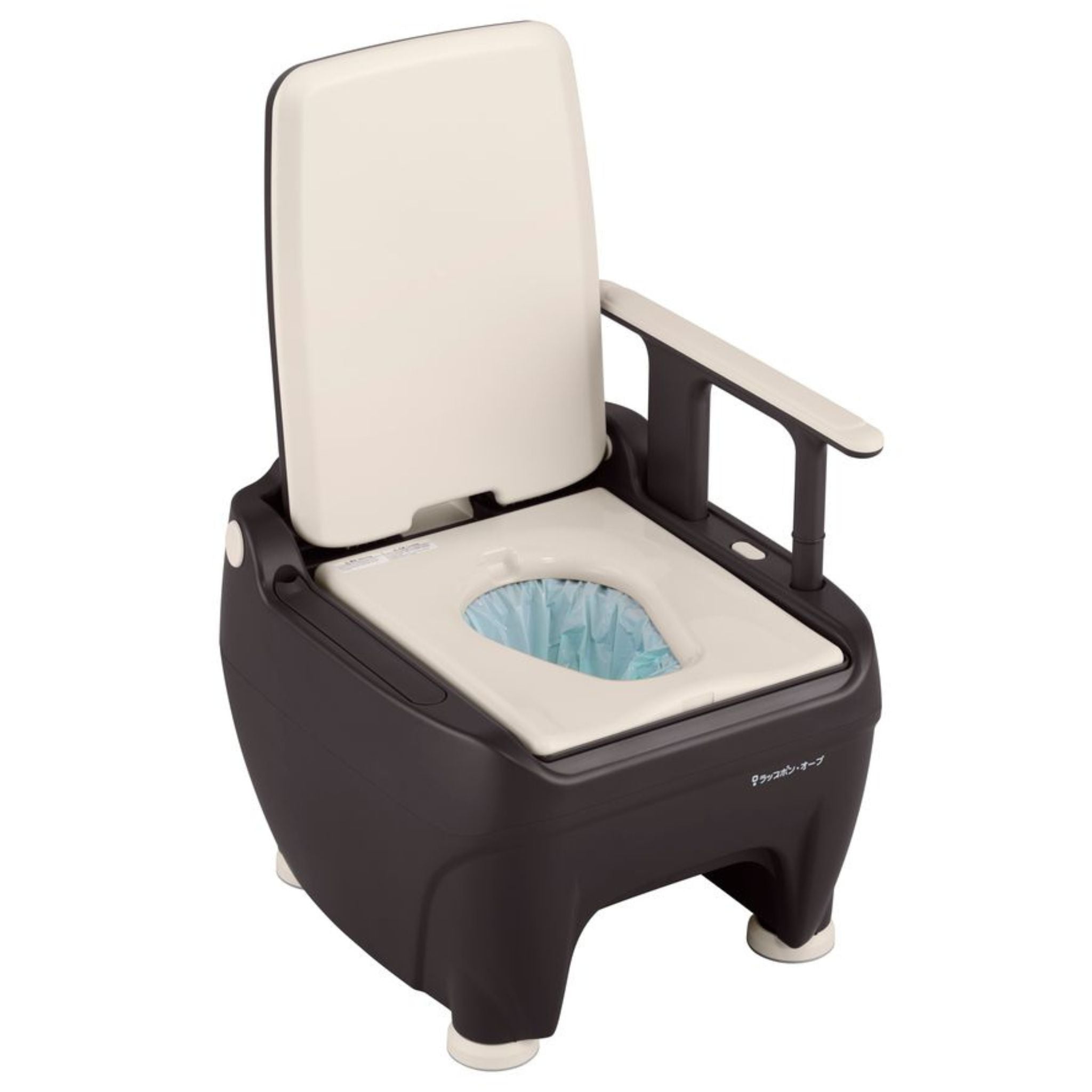
Advanced models such as the Wrappon ORB use coagulant, specialized film, and an automatic heat-wrapping mechanism instead of a conventional reusable bucket. This creates a different disposal process that can reduce the need to carry exposed waste through the home.
Common names for bedside commodes
Customers may encounter several names for this type of equipment:
- Bedside commode
- Commode chair
- Portable toilet chair
- Bedside toilet
- Adult portable toilet
- 3-in-1 commode
- Drop-arm commode
- Waterless portable toilet
These terms are often used interchangeably, but they do not always describe the same features. A basic bedside commode, for example, may not be suitable for lateral wheelchair transfers, shower use, or placement over an existing toilet.
Who May Benefit From a Bedside Commode?
A bedside commode may help when the distance, layout, or physical effort required to reach a bathroom makes regular toileting difficult or unsafe. It can be used temporarily during recovery or as part of a longer-term home-care arrangement.
A commode may be worth considering when:
- The bathroom is too far from the bedroom.
- The bathroom is located on another floor.
- Walking at night presents a fall concern.
- The user has limited endurance or becomes fatigued easily.
- A conventional toilet is too low for comfortable sitting and standing.
- The user needs armrests for leverage.
- A wheelchair will not fit easily into the bathroom.
- The user is recovering from surgery or an injury.
- A caregiver needs a toileting option close to the bed.
- Plumbing or running water is unavailable.
- Emergency preparedness requires a backup toilet option.
Choosing a commode should be based on the user’s current abilities rather than age alone. Older adults, wheelchair users, people recovering from surgery, individuals with reduced endurance, and users receiving caregiver assistance may all have very different equipment needs.
Start With the User’s Transfer Ability
The safest commode is one that matches how the user actually moves from the bed, wheelchair, or standing position onto the seat. Transfer ability should be evaluated before comparing cosmetic features or prices.
Independent walking and turning
A person who can walk to the commode, turn, and lower into the seat may be comfortable with a standard adjustable-height model. Important features include a stable frame, secure armrests, non-slip feet, and a seat height that does not require an excessively deep squat.
Consider whether the user can:
- Approach the commode without losing balance.
- Turn in the available floor space.
- Reach both armrests.
- Control the descent onto the seat.
- Stand again without pulling the commode forward.
Stand-pivot transfer
During a stand-pivot transfer, the user rises from a bed or wheelchair, turns, and lowers onto the commode. A broad base, firm armrests, correct seat height, and enough clearance for the user’s feet are especially important.
The commode should be positioned so that the user can make the shortest practical turn without stepping around clutter, power cords, furniture, or loose rugs.
Lateral or sliding-board transfer
A lateral transfer moves the user sideways between a wheelchair, bed, and commode. Fixed armrests can block this movement, so a drop-arm, swing-away-arm, or fully removable-arm commode may be required.
For this type of transfer, evaluate:
- Whether one or both armrests move out of the way.
- Whether the release mechanism locks securely.
- The height difference between the commode and transfer surface.
- Whether a sliding board can be positioned correctly.
- Whether the frame remains stable when weight shifts sideways.
- Whether a caregiver has enough room to assist.
Users who depend on a transfer board or physical assistance should have their setup reviewed by an occupational therapist, physical therapist, nurse, or other qualified professional.
Caregiver-assisted transfer
A commode does not make an unsafe transfer safe by itself. When a caregiver provides physical assistance, there must be enough room to stand, guide the user, operate removable armrests, and use any prescribed transfer equipment.
Consider:
- Access from one or both sides of the commode.
- Room for a gait belt or transfer aid.
- Whether armrests can be removed without reaching across the user.
- Whether the bed and commode heights can be aligned.
- Whether wheels are present and can be locked.
- Whether the caregiver has received appropriate transfer training.
Patient-lift or highly dependent transfer
A person who cannot stand or assist consistently may need a specialized rolling commode, open-base commode, or model compatible with a patient lift. Standard bedside commodes are not automatically compatible with lift transfers.
Before purchasing equipment for a full-lift transfer, confirm base clearance, sling access, seat design, caregiver space, and manufacturer-approved use. Explore our patient lifts or review the Patient Lift Buying Guide for additional information.

Types of Bedside Commodes
Bedside commodes are available in several configurations. The correct category depends on where the commode will be used, how the user transfers, how much space is available, and who will handle cleaning and disposal.
Standard bedside commode
A standard bedside commode normally has a metal frame, armrests, a toilet seat, a backrest, and a removable bucket. Many models have telescoping legs so the seat height can be adjusted.
Best suited for: Users who can walk or complete a stand-pivot transfer and need a straightforward toileting option near the bed.
Advantages:
- Generally affordable.
- Simple construction.
- Often height-adjustable.
- Easy to position in a bedroom.
- Replacement buckets and liners may be readily available.
Considerations:
- The bucket must be carried, emptied, washed, and returned.
- Fixed arms may obstruct lateral transfers.
- Basic seats may be narrow or firm.
- Lightweight frames may feel less stable to some users.
3-in-1 bedside commode
A 3-in-1 commode is designed to perform three common functions:
- Freestanding bedside commode
- Raised toilet seat positioned over a household toilet
- Toilet safety frame with armrests around an existing toilet
Best suited for: Homes where the same equipment may be used in both a bedroom and bathroom.
Before placing a 3-in-1 commode over a toilet, measure the toilet height, bowl dimensions, bathroom clearance, and frame width. Confirm whether the model includes a splash guard and whether the bucket can be removed without interfering with the household toilet.
A 3-in-1 designation does not automatically mean the product can be used in a shower. Shower use must be specifically approved by the manufacturer.
Drop-arm or removable-arm commode
A drop-arm commode has an armrest that lowers, swings away, or detaches to open a side-transfer path. This can make it easier to move between the commode and a bed or wheelchair.
Best suited for: Wheelchair users, sliding-board transfers, lateral transfers, and certain caregiver-assisted transfers.
Check whether:
- One or both arms can be moved.
- The arm release can be operated by the user or caregiver.
- The armrest locks positively when returned to position.
- The armrest is designed to bear weight during sitting and standing.
- The seat height is compatible with the transfer surface.
Bariatric or extra-wide commode
A bariatric commode is designed with a stronger frame, wider seat, increased space between the arms, or a higher weight capacity. These characteristics vary significantly between models.
Best suited for: Users who require greater seat width, additional arm spacing, a stronger frame, or a higher weight rating.
Do not select a bariatric commode based on weight capacity alone. Confirm:
- Maximum user weight.
- Usable seat width.
- Width between the armrests.
- Seat depth.
- Overall width.
- Doorway clearance.
- Available space beside the bed.
- Bucket size and accessibility.
A high weight rating does not guarantee that the seat or arm spacing will comfortably fit the user.
Padded bedside commode
Padded commodes use cushioned seating, a padded backrest, padded arms, or a combination of these features.
Best suited for: Users who find rigid plastic uncomfortable or who may remain seated longer during toileting and personal care.
Evaluate the upholstery carefully. Seams, tears, and textured surfaces can make cleaning more difficult. Thick padding can also change the effective seat height and transfer relationship.
A padded seat should not be assumed to prevent pressure injuries. Users with skin-integrity or positioning concerns should be evaluated by an appropriate healthcare professional.
Folding or travel commode
A folding commode collapses for storage or transportation. It can be useful in temporary lodging, travel, emergency planning, or homes with limited storage space.
Best suited for: Occasional use, travel, short-term recovery, or backup toileting.
Before purchasing, compare:
- Folded dimensions.
- Assembled weight.
- Seat width and height.
- Locking joints.
- Bucket security.
- Tool-free assembly.
- Stability after unfolding.
Rolling commode or shower commode
A rolling commode has casters and may be used to move a user between a bedroom, bathroom, toilet, and shower when the manufacturer approves those functions.
Best suited for: Assisted toileting and bathing when the user needs to remain seated during transport.
Important features may include:
- Locking casters.
- Corrosion-resistant construction.
- Swing-away footrests.
- Caregiver push handles.
- Positioning supports when prescribed.
- Clearance over a household toilet.
- Removable or swing-away arms.
A standard bedside commode should never be converted into a transport chair by adding unapproved wheels. Shop manufacturer-approved shower chairs and related bathing equipment when wet-area use is required.
Automatic-wrapping bedside commode
An automatic-wrapping commode uses specialized film and a heat-sealing mechanism to wrap waste after each use. A coagulant is generally added before use to absorb liquid and prepare the contents for wrapping.
Best suited for: Households and care settings where carrying and cleaning an open waste bucket is a significant concern.
Potential advantages include:
- Individually contained waste after each cycle.
- No conventional bucket-emptying workflow during normal operation.
- Waterless operation.
- Reduced direct handling of collected waste.
- A useful option where plumbing is not readily accessible.
Important considerations include:
- Higher initial equipment cost.
- Ongoing film and coagulant purchases.
- Electrical power requirements.
- Cycle time.
- Product-specific weight capacity.
- Keeping compatible supplies in stock.
How to Measure for a Bedside Commode
Correct measurements help determine whether a commode will support comfortable posture, safe transfers, and practical placement in the home. Compare the user’s measurements with the manufacturer’s published specifications rather than relying only on labels such as standard, wide, or bariatric.

1. Confirm the user’s weight
Choose a commode with a maximum user-weight rating that safely accommodates the user. Never exceed the manufacturer’s stated capacity.
Weight capacity describes the load the product is designed to support. It does not indicate whether the seat width, seat depth, arm spacing, or overall dimensions will fit the user.
2. Measure hip and thigh width
Have the user sit in a stable chair and measure across the widest point of the hips and thighs. Compare that measurement with the usable width between the commode’s armrests.
A seat that is too narrow may create pressure, restrict clothing, or interfere with personal care. A commode that is excessively wide may place the armrests too far away to provide effective support.
3. Check the width between the armrests
The width between the arms can be more important than the advertised seat width. Measure the clear space between the inside surfaces of the armrests and account for any brackets, padding, release mechanisms, or tapered areas.
4. Measure seat width
Measure the usable sitting surface, not only the outside width of the seat. A molded or contoured seat may have less usable space than its overall dimension suggests.
5. Measure seat depth
Seat depth is measured from the back of the usable seat surface to the front edge. A seat that is too deep may place pressure behind the knees, while one that is too shallow may provide insufficient thigh support.
6. Determine the correct seat height
A properly adjusted seat generally allows the user to sit with both feet supported and the knees in a comfortable position. The seat should be high enough to reduce excessive bending but not so high that the user’s feet cannot reach the floor.
One useful starting measurement is the distance from the floor to the crease behind the user’s knee while wearing the footwear normally used for transfers.
Also consider:
- The height of the bed or wheelchair.
- The user’s ability to rise from a low surface.
- Whether the user tends to slide forward.
- Whether the feet will remain supported.
- The thickness of any approved seat padding.
7. Measure armrest height
Measure from the top of the seat to the top of the armrest. The arms should be reachable without forcing the shoulders upward or causing the user to lean excessively to one side.
8. Measure the toilet opening
Compare the width, length, and position of the opening. Consider personal hygiene access, splash control, comfort, and alignment with the bucket or film system beneath the seat.
9. Measure overall width and depth
Measure the commode’s widest and deepest points, including armrests, release levers, wheels, footrests, and protruding accessories.
Then measure:
- Bedroom doorway width.
- Hallway clearance.
- Space between the bed and wall.
- Distance between nearby furniture.
- Wheelchair approach space.
- Caregiver working space.
- Patient-lift base clearance where applicable.
10. Evaluate bed-transfer height
For lateral transfers, the commode and bed or wheelchair should have a manageable height relationship. A large height difference can make transferring more difficult even when an armrest is removable.
A healthcare professional should evaluate transfer height when the user requires a sliding board, physical assistance, or specialized positioning.
Bedside Commode Features to Consider Before Buying

Frame stability
The frame should remain steady as the user approaches, turns, sits, shifts position, and stands. Look for a wide base, secure cross-bracing, correctly installed adjustment pins, and all feet contacting a firm, level surface.
Inspect for:
- Side-to-side wobble.
- Loose fasteners.
- Bent tubing.
- Cracked plastic.
- Uneven leg adjustments.
- Missing rubber tips.
Non-slip feet
Rubber feet help resist movement on smooth flooring. They should be intact, clean, and fully seated on the legs. Replace worn or damaged tips with manufacturer-compatible parts.
Armrest design
Armrests can provide leverage during sitting and standing, support posture, and assist with transfers. Common designs include:
- Fixed arms
- Padded arms
- Drop arms
- Swing-away arms
- Fully removable arms
- Height-adjustable arms
Verify whether the armrests are designed to bear weight. Do not assume every removable or padded arm can safely support a forceful push during standing.
Backrest
A backrest can provide positioning support while the user is seated. Compare fixed, removable, folding, and padded designs.
A commode backrest should not be treated as a restraint or relied upon to prevent a fall. Users who lean heavily, slide, or cannot maintain seated posture may require a more specialized seating system.
Seat material and contour
Rigid plastic is common because it is generally easy to wipe clean. Contoured or padded seats may improve comfort, but seams and upholstery can require more careful maintenance.
Examine:
- Seat-edge shape.
- Surface texture.
- Temperature and firmness.
- Skin contact points.
- Ease of removal.
- Compatibility with cleaning products.
Open-front versus closed-front seat
An open-front seat may provide easier hygiene access for some users. A closed-front seat may feel more familiar or supportive to others. The best design depends on comfort, positioning, clothing management, and caregiver access.
Height adjustment
Many commodes use telescoping legs with push-button adjustment holes. Every leg must be set to the same intended position unless the manufacturer specifically authorizes another configuration.
Confirm that all buttons or pins extend completely through their openings before use.
Bucket design
Traditional commode buckets vary in shape, capacity, handle design, lid fit, and removal direction.
Look for:
- A secure lid.
- A strong carrying handle.
- Smooth, easy-to-clean surfaces.
- A splash guard when used over a toilet.
- Top or rear removal that works in the available space.
- Compatibility with approved disposable liners.
Wheels and brakes
Rolling commodes should have manufacturer-approved casters and reliable wheel locks. Lock every required caster before the user transfers, unless the product instructions state otherwise.
Do not use an occupied rolling commode for transport unless the manufacturer specifically approves it for that purpose.
Footrests
Footrests may be required when a rolling commode transports an occupied user. During transfers, they should move safely out of the way to reduce trip and obstruction hazards.
Foldability and storage
Folding models can save space and simplify travel, but the frame must lock securely when opened. Confirm that no folding joints can collapse unintentionally during use.
Cleaning access
Look for smooth surfaces, removable components, minimal crevices, and access to areas beneath the seat. Complicated hinges, exposed hardware, and damaged upholstery can make thorough cleaning more difficult.
Appearance and discretion
Some commodes use furniture-like styling or concealed waste components to blend into a bedroom. Appearance may help the equipment feel less clinical, but cleaning access, fit, and transfer safety should remain the primary considerations.
Compare Bedside Commode Waste-Management Options
The waste-management method affects caregiver workload, recurring costs, odor containment, cleaning requirements, and how waste is carried through the home.
| Waste System | How It Works | Primary Advantage | Main Consideration |
|---|---|---|---|
| Reusable bucket | Waste collects in a removable pail that is emptied and cleaned. | Low ongoing supply cost. | Requires carrying, emptying, washing, and disinfecting the bucket. |
| Disposable liner | A single-use liner is placed inside the bucket. | Can reduce direct bucket cleanup. | Requires correct fit and careful removal to avoid leakage. |
| Absorbent liner system | A liner and absorbent pad or powder help solidify liquid. | Helps stabilize contents before disposal. | Creates recurring supply costs and must be disposed of properly. |
| Automatic wrapping | Film and coagulant are used to wrap waste after each cycle. | Creates an individually contained package and avoids normal bucket emptying. | Requires compatible consumables, electrical power, and a higher initial investment. |
Traditional reusable bucket
A reusable bucket is economical and widely available. It may be practical when a toilet and cleaning area are close by and the caregiver can safely carry the container.
However, the process normally includes:
- Removing the bucket from the commode.
- Covering it with a lid.
- Carrying it to a toilet.
- Emptying the contents.
- Washing and disinfecting the bucket.
- Drying and reinstalling it.
Disposable liners
Disposable liners can simplify cleanup, particularly during travel or temporary use. Confirm that the liner is compatible with the bucket, will remain secure during use, and can be closed without spilling.
Do not use an ordinary household trash bag unless the commode manufacturer permits it. Thin or oversized bags may shift, tear, or obstruct the seat.
Absorbent liners and coagulants
Absorbent pads or coagulant powders help convert liquid into a more stable material. Use only products approved for the specific commode or liner system.
Automatic heat-wrapping system
An automatic wrapping system uses specialized film and a heat-sealing mechanism to form a separate waste package after use. The Wrappon ORB combines this process with compatible coagulant to provide a waterless alternative to a reusable bucket.
Featured Advanced Option: Wrappon ORB Auto-Wrapping Portable Toilet System
The Wrappon ORB Auto-Wrapping Portable Toilet System is designed for users and caregivers who want an alternative to carrying, emptying, and repeatedly cleaning a conventional commode bucket.
After use, the ORB automatically advances, heat-seals, and cuts its specialized film. The wrapped package can then be removed from the lower collection area and discarded in accordance with Wrappon’s approved U.S. disposal instructions and applicable local requirements.

How the Wrappon ORB works
- Confirm that the compatible ORB film cassette is installed correctly.
- Add the designated Wrappon coagulant before use.
- Use the commode normally.
- Press the wrapping button when finished.
- Allow the approximately 90-second automatic cycle to complete.
- Open the lower area and remove the individually wrapped package.
- Dispose of it according to Wrappon’s approved U.S. instructions and applicable local requirements.
The coagulant absorbs liquid and prepares the contents for wrapping. The film is then advanced, heat-sealed, and cut by the ORB mechanism.
Why the ORB offers a different caregiver workflow
With a traditional commode, a caregiver may need to carry an open or lidded bucket to the bathroom after every use. The ORB replaces that routine with an automatic wrapping cycle and a contained package.
This may help:
- Avoid carrying an open bucket of waste.
- Reduce repeated bucket-emptying and rinsing.
- Contain each use in a separate film package.
- Support toileting in a bedroom without nearby plumbing.
- Simplify waste handling for some family and professional caregivers.
- Provide a waterless toileting option for home care and preparedness.
The ORB does not eliminate all cleaning. The toilet seat, lid, armrests, controls, exterior surfaces, and any soiled areas still require care according to the manufacturer’s instructions.
Wrappon ORB comfort and transfer features
The ORB combines its automatic waste system with a chair-style design intended for home and care use.
- Removable armrests for appropriate side access and transfers
- Three adjustable seat-height positions
- Supportive backrest
- Broad molded base
- Polypropylene-resin construction
- Smooth surfaces for routine care
- Integrated automatic wrapping mechanism
- Compatible ORB film and coagulant system
Wrappon ORB specifications
| Product name | Wrappon ORB Auto-Wrapping Portable Toilet System |
|---|---|
| Maximum user weight | 220 lbs |
| Product weight | Approximately 37.5 lbs |
| Overall dimensions | Approximately 21.7 in. L × 23.3 in. D × 36.7–39.1 in. H |
| Seat width | Approximately 21.4 in. |
| Seat-height settings | Approximately 15.7, 16.9, and 18.1 in. |
| Seat-to-armrest height | Approximately 8.3 in. |
| Chair material | Polypropylene resin |
| Power configuration | U.S. household power; no separate adapter purchase required |
| Wrapping-cycle time | Approximately 90 seconds |
| Film cassette capacity | Approximately 60 uses, depending on use and film advancement |
| Starter supplies | Not included; film and coagulant must be ordered separately |
| Color options | No optional colors |
| Casters | Not available for the U.S. ORB configuration offered by ILS |
| Backup bucket | Not included or offered with the U.S. configuration |
Important: The ORB has a maximum user-weight rating of 220 lbs. It is not a bariatric commode. Users who exceed or are close to this limit should select another appropriately rated model.
Required ORB consumables
The ORB does not include starter supplies. Compatible film and coagulant must be purchased separately before the commode can perform its automatic wrapping process.
- Wrappon ORB Film Cassette Replacement — provides approximately 60 uses.
- Wrappon ORB Coagulant Powder Packets, 50 Count — absorbs liquid before the wrapping cycle.
Keep enough film and coagulant on hand for the expected frequency of use. ORB consumables are product-specific and should not be replaced with unapproved film, household bags, or unrelated absorbent powders.
Who may benefit most from the Wrappon ORB?
The ORB may be a strong option for:
- Users who weigh no more than 220 lbs.
- Households where a caregiver normally empties the commode.
- Bedrooms located far from a bathroom.
- Homes where carrying a bucket through living areas is undesirable.
- Users who benefit from removable armrests.
- Care settings seeking individually contained waste after each use.
- Locations where a waterless portable toilet is useful.
- Customers willing to maintain film and coagulant supplies.
Who should consider another commode?
Another model may be more appropriate for:
- Users over or near the 220 lb maximum.
- People who require a bariatric or extra-wide commode.
- Users who need an approved rolling shower commode.
- People requiring a fully mechanical device without electricity.
- Households that do not want proprietary consumables.
- Travelers who need an ultralight folding commode.
- Users who need casters or transport capability.
- Situations requiring a patient-lift-compatible open base.
Wrappon ORB warranty and service
Wrappon’s manual refers owners to the written warranty supplied with the product and to the selling dealer for warranty and after-sale service. Because a fixed warranty duration is not stated in the available ORB documentation, customers should retain their dated proof of purchase, written warranty materials, product serial number, and original documentation.
Contact Independent Living Superstore before ordering when warranty coverage or service procedures are a deciding factor.
Caregiver Considerations
A commode should work for both the user and the person responsible for transfers, cleaning, supplies, and disposal. A model that appears simple for the user may create an impractical workload for a caregiver.
Who will empty or dispose of the waste?
Consider:
- Whether the user can manage the bucket or package independently.
- The distance to the nearest toilet.
- Whether stairs must be used.
- Whether the caregiver can safely carry a filled bucket.
- Whether a suitable cleaning sink or area is available.
- Whether liners or consumables will be kept within reach.
Can the caregiver access the user safely?
Leave enough room for the caregiver to stand beside or in front of the user without twisting, reaching across furniture, or lifting from an awkward position.
Can the commode be cleaned easily?
Caregivers should be able to reach the seat underside, armrests, handles, lid, controls, and surrounding surfaces. Removable parts should detach and reinstall without excessive force.
Can supplies be stored nearby?
A practical commode station may include:
- Disposable gloves.
- Toilet tissue or manufacturer-approved wipes.
- Cleaning supplies.
- Replacement liners.
- Wrappon film and coagulant when using the ORB.
- Personal-care items.
- A covered waste receptacle where appropriate.
Privacy and dignity
Position the commode where the user can maintain as much privacy as possible. A privacy screen, robe, adaptive clothing, quiet disposal process, and respectful caregiver communication can make the experience feel less clinical.
Commode Placement and Nighttime Safety
The commode should be close enough to reduce unnecessary walking but far enough from the bed to permit safe standing, turning, and caregiver access.
Choose the transfer side carefully
Place the commode on the side of the bed the user normally exits, unless a clinician has recommended another arrangement. Consider the stronger side, surgical precautions, wheelchair placement, and caregiver position.
Keep the floor clear
Remove:
- Loose rugs.
- Electrical cords.
- Footstools.
- Unstable furniture.
- Clothing or bedding on the floor.
- Items that reduce turning space.
Provide nighttime lighting
Use a night-light, bedside lamp, or motion-activated light so the user can see the commode, floor, bed edge, and any mobility aid.
Keep mobility equipment accessible
A walker, cane, wheelchair, call bell, or phone should be positioned where the user can reach it without leaning dangerously. Review our rollators and walkers and the Rollator, Walker and Cane Buying Guide for related mobility support.
Protect power cords
For powered commodes such as the Wrappon ORB, route the cord away from the user’s feet, walker, wheelchair, and caregiver path. Do not place the cord beneath the commode or where it can be pinched by furniture.
Cleaning and Maintenance
Follow the manufacturer’s cleaning instructions for the exact model. Materials differ, and a cleaner that is appropriate for one commode may damage another.
Traditional bucket cleaning
- Put on appropriate disposable gloves when needed.
- Remove the bucket carefully and apply its lid.
- Carry the bucket to an appropriate toilet.
- Empty the contents without splashing.
- Wash and disinfect according to the product instructions.
- Clean the toilet seat, lid, splash guard, armrests, and touch points.
- Allow the components to dry.
- Reinstall the bucket securely.
Disposable liner care
Remove liners according to their instructions. Avoid compressing an open liner or forcing excess air toward the opening. Check the bucket for leakage or contamination before installing a new liner.
Wrappon ORB cleaning
The ORB’s automatic wrapping system reduces normal bucket handling, but routine surface care remains necessary.
Clean:
- Seat and lid.
- Armrests.
- Backrest.
- Controls and frequently touched surfaces.
- Lower collection area if soiled.
- Exterior body.
Do not pour water over the ORB, submerge electrical components, or spray liquid directly into its powered wrapping mechanism. Unplug the unit before performing maintenance that requires access near the internal film area, following the owner’s manual.
General cleaning cautions
- Never mix cleaning chemicals.
- Check material compatibility before using bleach or alcohol.
- Replace cracked seats, damaged padding, and worn rubber feet.
- Inspect adjustment pins and fasteners regularly.
- Keep electrical plugs and controls dry.
- Follow facility infection-control procedures in professional settings.
Bedside Commode Safety Checklist
- Confirm the user is within the stated weight capacity.
- Verify that the seat width and arm spacing fit the user.
- Set every adjustable leg to the correct matching height.
- Make sure all buttons, pins, and clips are fully engaged.
- Place all feet on a firm, level surface.
- Lock every required caster before transfers.
- Remove rugs, cords, clutter, and unstable furniture.
- Position the commode on the safest transfer side.
- Keep the route illuminated at night.
- Confirm the bucket, liner, film, or cassette is installed correctly.
- Make sure removable arms lock securely after a transfer.
- Never stand on the commode.
- Do not move a standard commode while occupied.
- Do not use a commode in the shower unless it is specifically approved.
- Reassess the equipment whenever the user’s mobility or weight changes.
Bedside Commode Comparison Chart
| Commode Type | Best Suited For | Typical Transfer | Waste System | Primary Advantage | Main Consideration |
|---|---|---|---|---|---|
| Standard bedside commode | Basic bedroom or recovery use | Walking or stand-pivot | Reusable bucket | Simple and affordable | Bucket requires regular emptying and cleaning |
| 3-in-1 commode | Bedroom and over-toilet use | Walking or stand-pivot | Bucket or household toilet | Multiple functions in one frame | Must fit the toilet and bathroom layout |
| Drop-arm commode | Wheelchair and lateral transfers | Side transfer or assisted transfer | Reusable bucket or liner | Clearer side access | Arm mechanism must lock securely |
| Bariatric commode | Users requiring greater capacity or width | Varies | Reusable bucket or liner | Stronger and wider construction | Requires more bedroom and doorway space |
| Padded commode | Users seeking a softer seating surface | Varies | Reusable bucket or liner | Improved surface comfort | Padding and seams may be harder to clean |
| Folding travel commode | Travel, storage, and temporary use | Walking or stand-pivot | Bucket or liner | Compact storage | Must be fully locked before use |
| Rolling shower commode | Assisted toileting, bathing, and approved transport | Assisted or lift transfer | Bucket or household toilet | Can combine mobility and hygiene functions | Higher cost and more complex setup |
| Wrappon ORB | Users up to 220 lbs prioritizing contained waste handling | Appropriate stand-pivot or removable-arm transfer | Automatic film wrapping with coagulant | Avoids normal open-bucket emptying | Requires power and compatible consumables |
Quick Recommendations by Situation
Best for short-term recovery
A stable, adjustable-height 3-in-1 commode may provide the flexibility needed during recovery and can often transition from bedside use to placement over a household toilet.
Best for wheelchair transfers
Consider a drop-arm or removable-arm commode selected according to the user’s prescribed transfer technique and seat-height needs.
Best for larger users
Choose a bariatric commode only after confirming maximum weight, usable seat width, arm spacing, seat depth, doorway clearance, and room footprint.
Best for travel
A folding commode may be easier to store and transport, provided it offers adequate stability and correct dimensions.
Best for shower and toilet transport
Use a manufacturer-approved rolling shower commode with locking casters, corrosion-resistant materials, and the required positioning features.
Best for reducing open-bucket handling
The Wrappon ORB Auto-Wrapping Portable Toilet System may be appropriate when the user is within its 220 lb maximum and the household wants an automatic, waterless waste-wrapping process.
Calculate the Total Cost of Ownership
The lowest purchase price does not always produce the lowest long-term cost or the most manageable care routine.
Include the following when comparing models:
- Initial commode price.
- Disposable liners.
- Absorbent pads or coagulant.
- Replacement film cassettes.
- Cleaning and disinfecting supplies.
- Replacement buckets and lids.
- Replacement rubber feet.
- Seat or armrest replacements.
- Shipping costs.
- Expected uses per day.
- Caregiver time spent emptying and cleaning.
For the Wrappon ORB, the value is not limited to the chair itself. Its primary distinction is the change from a reusable-bucket workflow to automatic individual wrapping. Compare that benefit with the recurring cost of compatible film and coagulant.
When to Request a Professional Assessment
Consult an occupational therapist, physical therapist, nurse, physician, or other qualified professional when:
- The user has fallen recently.
- Transfers require physical assistance.
- A sliding board is used.
- The user cannot consistently stand.
- A patient lift is required.
- The user leans, slides, or loses balance while seated.
- The correct seat height is uncertain.
- The user is returning home after major surgery.
- Body dimensions are close to the product limits.
- The bedroom or bathroom layout is unusually restricted.
- The caregiver is unsure how to assist safely.
Final Bedside Commode Buying Checklist
Before ordering, confirm each of the following:
- User’s current weight
- Maximum commode weight capacity
- Hip and thigh width
- Usable width between the armrests
- Seat width and depth
- Required seat-height range
- Armrest height
- Transfer method
- Need for drop or removable arms
- Need for approved shower use
- Need for wheels or transport capability
- Bedroom and doorway clearance
- Caregiver working space
- Bucket, liner, or automatic-wrapping preference
- Power availability
- Cost and availability of replacement supplies
- Cleaning and disposal routine
- Whether professional assessment is needed
Browse the complete bedside commode collection to compare available models and waste-management options.
Frequently Asked Questions About Bedside Commodes
What is the difference between a bedside commode and a portable toilet?
A bedside commode is a type of portable toilet designed with a chair-style seat, armrests, and a waste container or containment system. “Portable toilet” is a broader term that may also describe camping toilets, emergency toilets, folding systems, or other waterless designs that are not intended specifically for bedside care.
What does 3-in-1 bedside commode mean?
A 3-in-1 commode is generally designed for three uses: as a freestanding bedside commode, as a raised toilet seat over a household toilet, and as a toilet safety frame with armrests. Confirm the manufacturer’s instructions because dimensions, included splash guards, and approved uses vary between models.
How high should a bedside commode be?
The seat should generally allow the user to sit with supported feet and comfortable knee positioning while reducing excessive bending during standing. Measure from the floor to the crease behind the knee as a starting point, then consider bed height, wheelchair height, footwear, transfer method, and the user’s strength.
How do I know whether a commode is wide enough?
Measure the widest point across the user’s hips and thighs while seated, then compare it with the usable width between the armrests. Also verify the seat width and depth. A listed weight capacity alone does not confirm that the user will fit comfortably between the arms.
When is a drop-arm commode needed?
A drop-arm or removable-arm commode may be needed when a fixed armrest would block a lateral transfer from a wheelchair or bed. The open side can provide space for a sliding board or assisted transfer. A clinician should evaluate transfers when the user cannot move independently.
Can a bedside commode be placed over a regular toilet?
Only commodes designed for over-toilet use should be placed above a household toilet. Confirm the frame width, seat height, bowl clearance, splash-guard requirements, and bathroom space. A standard bucket-only bedside commode may not fit or remain stable over the toilet.
Can every bedside commode be used in the shower?
No. A commode should be used in a shower only when the manufacturer specifically approves it for wet environments. Standard steel frames, padded components, electrical parts, and non-water-resistant hardware may be damaged or become unsafe when exposed to water.
How can bedside commode odors be reduced?
Empty and clean traditional buckets promptly, use secure lids and compatible liners, and follow the manufacturer’s cleaning directions. Approved absorbent products may help stabilize liquid. Automatic wrapping systems such as the Wrappon ORB individually contain each use in specialized film after coagulant is added.
How often should a bedside commode be emptied?
A traditional commode bucket should generally be emptied promptly after use or according to the user’s care plan and facility procedures. Do not allow waste to accumulate beyond the bucket’s safe capacity. Automatic-wrapping models create a separate package after each completed cycle.
What is an automatic-wrapping bedside commode?
An automatic-wrapping commode uses designated film, coagulant, and a powered heat-sealing mechanism to wrap waste after each use. The Wrappon ORB completes an approximately 90-second cycle and creates an individually contained package, reducing the need to carry and clean a traditional waste bucket.
Does the Wrappon ORB need electricity?
Yes. The Wrappon ORB requires U.S. household electrical power to operate its automatic film-advancing, sealing, and cutting mechanism. The U.S. configuration sold by Independent Living Superstore does not require the customer to purchase a separate voltage adapter.
Does the Wrappon ORB include film and coagulant?
No. Starter supplies are not included. Customers must order the compatible Wrappon ORB Film Cassette and Wrappon ORB Coagulant Powder Packets separately before using the automatic wrapping function.
How many uses are in a Wrappon ORB film cassette?
Each compatible ORB film cassette provides approximately 60 uses. Actual capacity may vary slightly based on film advancement and operating conditions. Keep a replacement cassette available when the ORB is relied upon for regular bedside toileting.
Is the Wrappon ORB suitable for bariatric users?
No. The Wrappon ORB has a maximum user-weight capacity of 220 lbs and should not be described as a bariatric commode. Users who exceed or approach the maximum should select a model with a higher published capacity and verify the usable seat and armrest dimensions.
Related Bathroom Safety and Home-Care Resources
- Shop Bedside Commodes
- Shop Bath and Shower Accessories
- Shop Shower Chairs
- Shop Transfer Benches
- Shop Patient Lifts
- Read the Bath and Hygiene Safety Buying Guide
- Read the Patient Lift Buying Guide
- Read the Rollator, Walker and Cane Buying Guide
Why Buy a Bedside Commode From Independent Living Superstore?
Independent Living Superstore carefully selects mobility, bathroom-safety, and home-care equipment to help individuals, families, and caregivers compare practical solutions for everyday living. Our team can help you review weight capacities, dimensions, transfer features, waste-management systems, and compatible supplies before ordering.
- Service-Disabled Veteran-Owned Small Business: Proudly veteran-owned and committed to serving individuals, families, caregivers, and organizations.
- Family-run company: We provide personal, responsive assistance rather than an impersonal one-size-fits-all approach.
- BBB A-rated business: Shop with a company focused on trust, communication, and responsible service.
- Carefully curated products: We select equipment intended to support mobility, safety, dignity, comfort, and greater independence.
- Product guidance: Our team can help compare specifications and identify required accessories or replacement supplies.
- Faith-driven values: We believe in treating every customer with honesty, compassion, and respect.
- No sales tax outside New York: Where applicable under current tax requirements.
Move Freely. Live Fully.
Independent Living Superstore is a retail medical-equipment supplier and does not bill Medicare, Medicaid, or private insurance. Product information is educational and is not a substitute for individualized medical, rehabilitation, or transfer advice.



Share:
Tilt-in-Space vs Standing Wheelchairs: Which Mobility Solution Is Right for You?
How to Outfit a Wheelchair or Mobility Scooter: Bags, Covers, Canopies & Holders