


If you're shopping for a wheelchair for yourself or someone you love, the number of options can feel overwhelming — standard, transport, bariatric, tilt-in-space, and more. The good news is that choosing the right manual wheelchair comes down to a few simple questions about who will use it, who will push it, and where daily life happens. This wheelchair buying guide walks you through each type in plain language so you can choose with confidence.
Quick Answer: Choose a standard manual wheelchair for everyday use with self-propelling ability, a lightweight wheelchair if the chair will be lifted into a car often, a transport wheelchair if a caregiver will do the pushing, a bariatric wheelchair for higher weight capacities and wider seating, a reclining or tilt-in-space wheelchair for people who spend long hours seated and need pressure relief, a standing wheelchair for the health and independence benefits of upright positioning, and an all-terrain wheelchair for sand, gravel, trails, and the outdoors.
Reviewed by the Independent Living Superstore team, a veteran-owned homecare equipment retailer.
Who Manual Wheelchairs Are Designed For
- Seniors who want dependable everyday mobility at home and in the community
- People recovering from surgery, injury, or illness who need short- or long-term seated mobility
- Caregivers and adult children helping a parent get to appointments, outings, and family events safely
- Individuals with limited endurance who can walk short distances but need support beyond that
- Users who spend extended time seated and need positioning, pressure relief, or postural support
Types of Manual Wheelchairs
Every manual wheelchair balances the same trade-offs: weight, capacity, comfort features, and how it gets from place to place. Here's how the main types compare at a glance.

| Wheelchair Type | Best For | Typical Weight Capacity | Key Feature |
| Standard | Everyday self-propelled use | Varies by model | Large rear wheels with hand rims |
| Lightweight / Ultra Lightweight | Frequent car transport and easier propelling | Varies by model | Frames as light as 25 lbs |
| Transport | Caregiver-pushed travel and appointments | Up to 350 lbs | Compact, foldable, easy-to-lift design |
| Bariatric | Larger users needing reinforced support | Up to 450 lbs | Wider seat and heavy-duty frame |
| Reclining | Long hours seated, position changes | Varies by model | Adjustable backrest angle with elevating legrests |
| Tilt-in-Space | Pressure relief and postural support | Varies by model | Seat tilts as a unit without sliding the user |
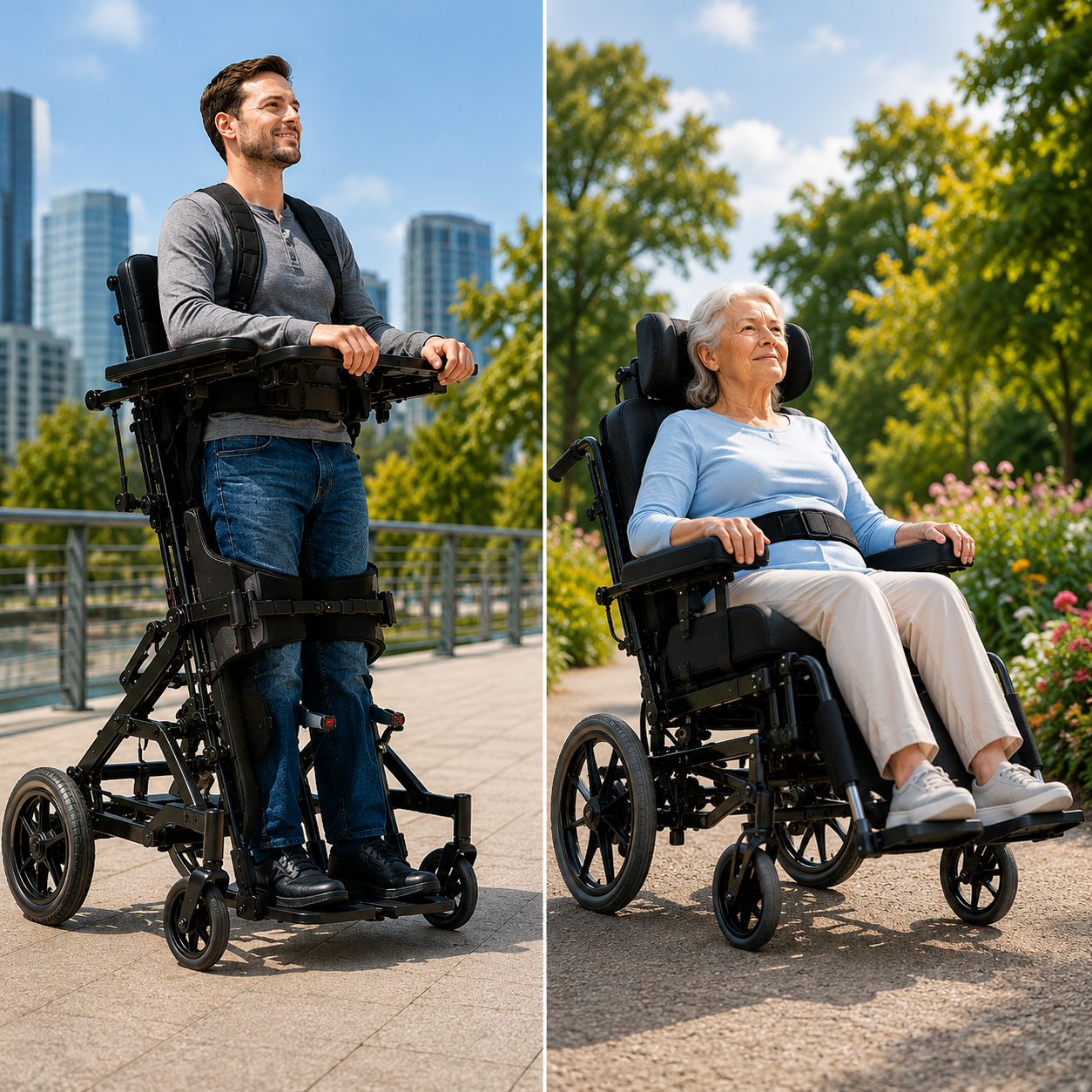
| Standing | Health benefits of upright positioning | Varies by model | Supports the user from seated to standing |
| All-Terrain | Sand, gravel, trails, and outdoor life | Varies by model | Rugged wheels built for uneven ground |
Standard Manual Wheelchairs
A standard manual wheelchair is the familiar workhorse: large rear wheels with hand rims for self-propelling, a folding frame, and footrest options to match the user's needs. It's the right starting point for most people who have the upper-body strength to move themselves and want dependable mobility at home, at church, and around the neighborhood.
Details matter more than they first appear. Swing-away footrests make standing transfers easier, elevating footrests support a leg that needs to stay raised, and hemi-height models adjust lower so shorter users can foot-propel comfortably.
Recommended standard wheelchairs: Chariot II Standard Hemi Wheelchair by Proactive Medical – Adjustable Manual Wheelchair, Chariot III Wheelchair (K3) With Swing Away Footrests, and the Chariot III Wheelchair (K3) With Elevating Footrest.
Lightweight Wheelchairs
A lightweight wheelchair earns its keep every single time it's lifted — into a trunk, up a step, or out of a closet. Less frame weight also means less effort with every push, which adds up over a full day for users who self-propel.

If lifting is a daily reality, an ultra lightweight model can be the difference between an outing that happens and one that doesn't. At just 25 lbs, the S-ERGO 115 is light enough for many caregivers to manage alone, with an ergonomic seat design for comfortable longer sits.
Recommended lightweight wheelchairs: Chariot IV XTC Lightweight Wheelchair and the S-ERGO 115 Ultra Lightweight Wheelchair only 25 lbs.
Transport Wheelchairs
A transport wheelchair is built around one honest assumption: someone else is doing the pushing. Smaller rear wheels make the chair lighter and more compact than a self-propelled model, which is exactly what you want for doctor visits, airports, restaurants, and family gatherings.

These chairs are a favorite of adult children caring for aging parents because they fold quickly, fit in nearly any trunk, and are simple to maneuver through tight spaces. Look for hand brakes for the caregiver's control on ramps and slopes.
Recommended transport wheelchairs: Ergo Lite-Ultra Lightweight Ergonomic Transport Wheelchair and the Platinum Health Hummingbird Lightweight Foldable Transport Wheelchair – 12" Rear Wheels, Hand Brakes & 350 lb Capacity.
Bariatric Wheelchairs
A bariatric wheelchair provides what standard chairs can't: a reinforced frame, a wider seat, and a higher weight capacity, so larger users get stability and comfort without worry. The right fit here isn't a luxury — a chair matched to the user's size protects both safety and dignity.
When comparing bariatric models, check seat width against the user's measurements and confirm the weight capacity with room to spare. Elevating leg rests and dual-axle height adjustment add everyday comfort and flexibility.
Recommended bariatric wheelchairs: Titus Bariatric Wheelchair With Elevating Leg Rests and the Bariatric Wheelchair McKesson Dual Axle Desk Length Arm Swing-Away Footrest 450 lbs. Weight Capacity. Browse the full Bariatric Manual Wheelchairs collection for more options.
Reclining Wheelchairs
A reclining wheelchair lets the backrest angle open up, so the user can shift from upright to a restful lean without leaving the chair. That flexibility matters for people who spend many hours seated, doze during the day, or need position changes for circulation and comfort.
Paired with elevating legrests, a recliner supports a nearly lying-down rest position — a real relief for users managing swelling or fatigue, and for caregivers who would otherwise assist with frequent transfers.
Recommended reclining wheelchairs: Chariot-RC Reclining Wheelchair With Elevating Legrests and the Karman VIP-515-TP Transport Tilt-in-Space Wheelchair — Lightweight Folding Reclining Wheelchair.
Tilt-in-Space Wheelchairs
A tilt in space wheelchair does something a recliner can't: it tilts the entire seat — back, cushion, and legrests together — so the user's posture stays supported while pressure shifts from the seat to the back. That makes it a caregiver favorite for loved ones who can't reposition themselves, are at risk of pressure sores, or tend to slide forward in a standard chair.
Because the body doesn't shear against the seat during tilting, these chairs also reduce the constant readjusting that wears on both user and caregiver through the day.
Recommended tilt-in-space wheelchairs: Karman VIP-515 Tilt-in-Space Manual Wheelchair – Lightweight Folding Positioning Chair and the Karman VIP-515-TP Transport Tilt-in-Space Wheelchair — Lightweight Folding Reclining Wheelchair.
Standing Wheelchairs
A standing wheelchair supports the user from a seated position into a supported standing one — and that changes more than the view. Standing time can support circulation, pressure relief, and everyday reach, while also restoring eye-level conversation with family and friends.
For many users, that blend of health benefit and everyday dignity makes a standing wheelchair one of the most life-changing pieces of mobility equipment available.
Recommended standing wheelchair: XO-55 Horizon Manual Standing Wheelchair.
All-Terrain Wheelchairs
An all-terrain wheelchair goes where standard chairs simply can't: beach sand, gravel paths, campgrounds, trails, and uneven yards. If the person you're shopping for misses fishing trips, beach days, or walks in the woods, this category is about getting those back.
These chairs trade compactness for capability, with rugged wheels and frames built for the outdoors. They're a popular choice for active families and for veterans who want to stay in the field.
Recommended all-terrain wheelchair: Extreme Motus All-Terrain Wheelchair. See every model in our All-Terrain Wheelchairs collection.
How to Choose a Manual Wheelchair
If you're wondering how to choose a wheelchair, start with the person, not the product. These four questions settle most decisions:
- Who does the moving? If the user will self-propel, choose a standard or lightweight wheelchair with large rear wheels. If a caregiver pushes, a transport wheelchair is lighter, simpler, and easier on everyone.
- How often does it ride in a car? Frequent trunk lifting points strongly toward a lightweight or ultra lightweight model — a few pounds saved matters several times a day.
- How many hours a day in the chair? Long daily sitting calls for a reclining wheelchair or tilt in space wheelchair for pressure relief and position changes; occasional use is fine in a standard or transport model.
- Where will it live? Measure home doorways before you buy, and match seat width to the user with the door in mind. For outdoor living beyond sidewalks, look at all-terrain models.
Considering powered mobility instead? Our Electric Wheelchair Buying Guide covers when a power chair makes more sense than a manual one. Or browse the full Manual Wheelchairs Collection to compare models side by side.
Wheelchair Accessories & Ramps
The right add-ons turn a good wheelchair into a comfortable daily companion — cushions, positioning supports, storage, and more. Browse the Manual Wheelchair Accessories collection, and see our Wheelchair Accessories Buyer's Guide for help choosing.
Getting in and out of the house safely matters just as much as the chair itself. Our Wheelchair Ramp Buying Guide explains how to pick the right ramp for your entryway, steps, or vehicle.
Why Buy From Independent Living Superstore
Independent Living Superstore is a veteran-owned, family-run business and a certified Service-Disabled Veteran-Owned Small Business (SDVOSB). We're BBB Accredited and focused on helping real families find equipment that works in real homes.
- HSA/FSA eligible purchases
- No sales tax outside New York
- White Glove delivery available on select items
- GovX military discount for those who served
Important Information
This guide is for general informational purposes only and is not medical advice. Please consult a healthcare professional about the right mobility equipment for your specific needs.
Independent Living Superstore does not bill Medicare, Medicaid, or private insurance.
Need Help Choosing?
Our team is happy to talk through your situation and help you find the right fit. Email support@independentlivingsuperstore.com or call (844) 795-2930.



Share:
Mobility Scooter Buying Guide – How to Choose the Right Scooter
Adaptive Clothing Buying Guide – How to Choose the Right Clothing